
Project No 6010584 · Survey of 100 visitors in four regions
The Cultural Path of Wine, VINE_ROUTE, approaches wine tourism as a way to connect heritage, local food, landscapes and contemporary travel experiences. To understand what visitors actually expect, a survey was conducted with 100 respondents, with 25 visitors from each of the Blagoevgrad, Haskovo, Kardzhali and Smolyan regions. The questionnaire explored travel habits, service quality, preferred combinations of activities and interest in cross-border journeys. The findings describe this particular sample; they are not statistically representative of all visitors or the population at large.
Interest extends well beyond previous participation
A key finding is the difference between people who have already experienced wine tourism and people who are curious but have not yet tried it. Some 44% of respondents reported previous experience, while a further 50% had no such experience but expressed interest. Only 6% were not interested. Together, the first two groups account for 94% of the sample. This should not be interpreted as a forecast of ticket sales. It does suggest, however, that accessible and clearly explained routes can appeal to a broader public, including visitors who do not consider themselves wine experts.
How the survey findings should be read
The survey involved 100 visitors equally distributed across Blagoevgrad, Haskovo, Kardzhali and Smolyan—25 in each region. The sample supports comparisons but is not nationally representative. Its percentages describe the participants and can inform the design of pilot routes. A crucial distinction is between past experience and future interest: 44% reported previous wine-tourism experience, 50% had no experience but expressed interest, and 6% expressed no interest. Accordingly, the combined 94% figure refers to experience or interest; it must not be interpreted as the proportion who have actually taken a wine-tourism trip.
Who are the surveyed visitors?
The sample includes visitors rather than local residents. Domestic tourists from other parts of Bulgaria account for 82%, visitors from Greece for 6%, and visitors from other countries for 12%. The most active age groups are well represented: 76% are aged between 26 and 60. These figures support practical offers for short breaks and weekend trips, along with information that is understandable in more than one language. Although the international component of the sample is limited, it is relevant to the development of a cross-border cultural route.
Travel is a shared experience
Most respondents prefer to travel with other people. A partner is the usual companion for 30%, family and children for 29%, and friends for 22%. A further 8% tend to travel alone and 11% with organised groups. The first three categories together account for 81% of respondents. Small groups need a reliable daily schedule, clear journey times, suitable meal stops, straightforward booking conditions and good access to sites. Combining wine with culture, food and nature also makes the journey attractive to members of the same group who may have different interests.
Key survey findings
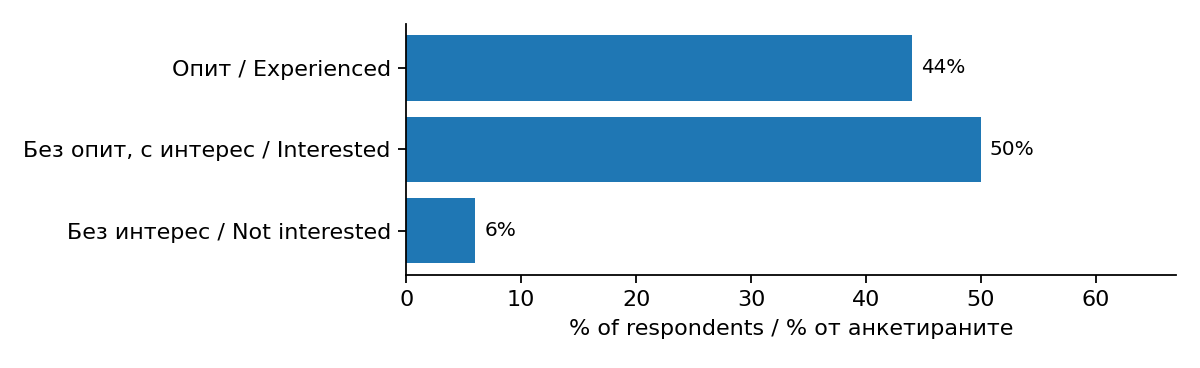
Figure 1. Wine tourism experience and interest among 100 surveyed visitors.
Practical conditions shaping route selection
Visitor profiles suggest offering a small number of clear, easy-to-plan itineraries rather than one overcomplicated tour. Respondents most often travel with a partner (30%), family (29%) or friends (22%), indicating the importance of small informal groups. They need advance information about stops, travel times, lunch options and whether tasting visits require reservations. One-day itineraries appeal to 37%, while 33% prefer two- or three-day visits. These findings support short route modules that can be combined into longer, more flexible programmes.
How long should a route last?
Trip duration strongly influences the appeal of a travel product. One-day routes are preferred by 37% of respondents, while 33% would choose a two- or three-day programme. Another 14% prefer experiences lasting only a few hours; 9% favour four days or more, and 7% have no preference. A single rigid itinerary would therefore be unlikely to meet every need. A modular approach is more promising: a short visit, a complete day route, and an extended version with accommodation, additional heritage stops and local culinary experiences.
Cross-border interest depends on practical arrangements
Asked about a Bulgaria–Greece route, 26% expressed strong interest and another 25% were generally positive. A further 19% would consider joining if organised transport were available. The potential audience thus reaches 70% when this transport-dependent group is included. The distinction matters: attractive sites alone do not make a cross-border itinerary workable. Visitors also need reliable transfers, up-to-date information, coordinated visiting hours and a realistic daily schedule. A cross-border route must be presented as a practical journey rather than a collection of points on a map.
Comparative table
| Indicator | Survey of 100 visitors |
|---|---|
| Domestic visitors | 82% |
| Other countries | 12% |
| Greece | 6% |
| Aged 26–60 | 76% |
| Travel with partner/family/friends | 81% |
Cross-border demand is conditional
For a combined Bulgaria–Greece route, 26% expressed strong interest and a further 25% a generally positive attitude. Another 19% would participate only if organised transport were available. The potential audience thus reaches 70%, but an important share is conditional. Cross-border offers need a checked transport option, logical stops, realistic timing and transparent participation conditions. The finding is not a forecast of bookings; it reveals the practical circumstances under which respondents might consider such a journey.
Implications for VINE_ROUTE
The survey supports the development of experiences for people with little specialised knowledge of wine. A useful itinerary should explain what each visit includes, how long it takes, how to book it and which cultural or natural sites can be combined with a tasting. Stories about local communities and traditions add meaning, but must be accompanied by practical details such as addresses, opening hours, access conditions and safe transport options. The aim for VINE_ROUTE is to turn initial curiosity into a wider, inclusive and well-organised visitor experience.
Moving from interest to a workable programme
The findings offer a basis for developing and testing route formats, without overstating market demand beyond the respondents. Priorities include a manageable number of logically connected stops, transport alternatives and transparent prices. Visitor information should be current and easy to understand in Bulgarian and English, with Greek-language needs considered for cross-border products. Combining heritage, wine and landscapes while respecting the distinct identity of each region can create routes that work both for experienced travellers and for people discovering wine tourism for the first time.
Development and communication priorities
A central communication task is to answer visitors’ practical questions before departure. Every itinerary should clearly state its start and end points, duration, transport arrangements, included visits, approximate costs and booking requirements. Descriptions for newcomers should use accessible language and avoid unnecessary specialist wine terminology. The survey also supports piloting itineraries with small groups, checking real visit and transfer times before presenting a route as a ready-to-book tourism product.
Implication for the project
Demand for wine-and-culture routes includes both experienced visitors and potential newcomers. Turning interest into actual visits will require clearly structured, easy-to-plan and operationally verified tourism products.
From findings to practical implementation
The first practical step is to distinguish two main audiences: visitors with prior wine-tourism experience and those who are interested but new to the format. Experienced visitors may value producer encounters, authentic stories and less familiar destinations. Newcomers are more likely to need certainty, a straightforward programme and an accessible combination of wine, culture, food and nature. Both can be served within a shared route through core and extended versions. Communication should clearly identify what is already available, what is still being tested and where reliable details can be obtained. After pilot trips, partners should track satisfaction, visit duration, transport use and willingness to return. The original survey can then serve as a baseline for further evaluation rather than simply as promotional evidence.
Source: VINE_ROUTE visitor survey analysis, 100 respondents (25 each from Blagoevgrad, Haskovo, Kardzhali and Smolyan). Percentages for multiple-response questions may total over 100%.
Project No 6010584 VINE_ROUTE · Co-funded by the European Union under Interreg VI-A Greece–Bulgaria 2021–2027.