
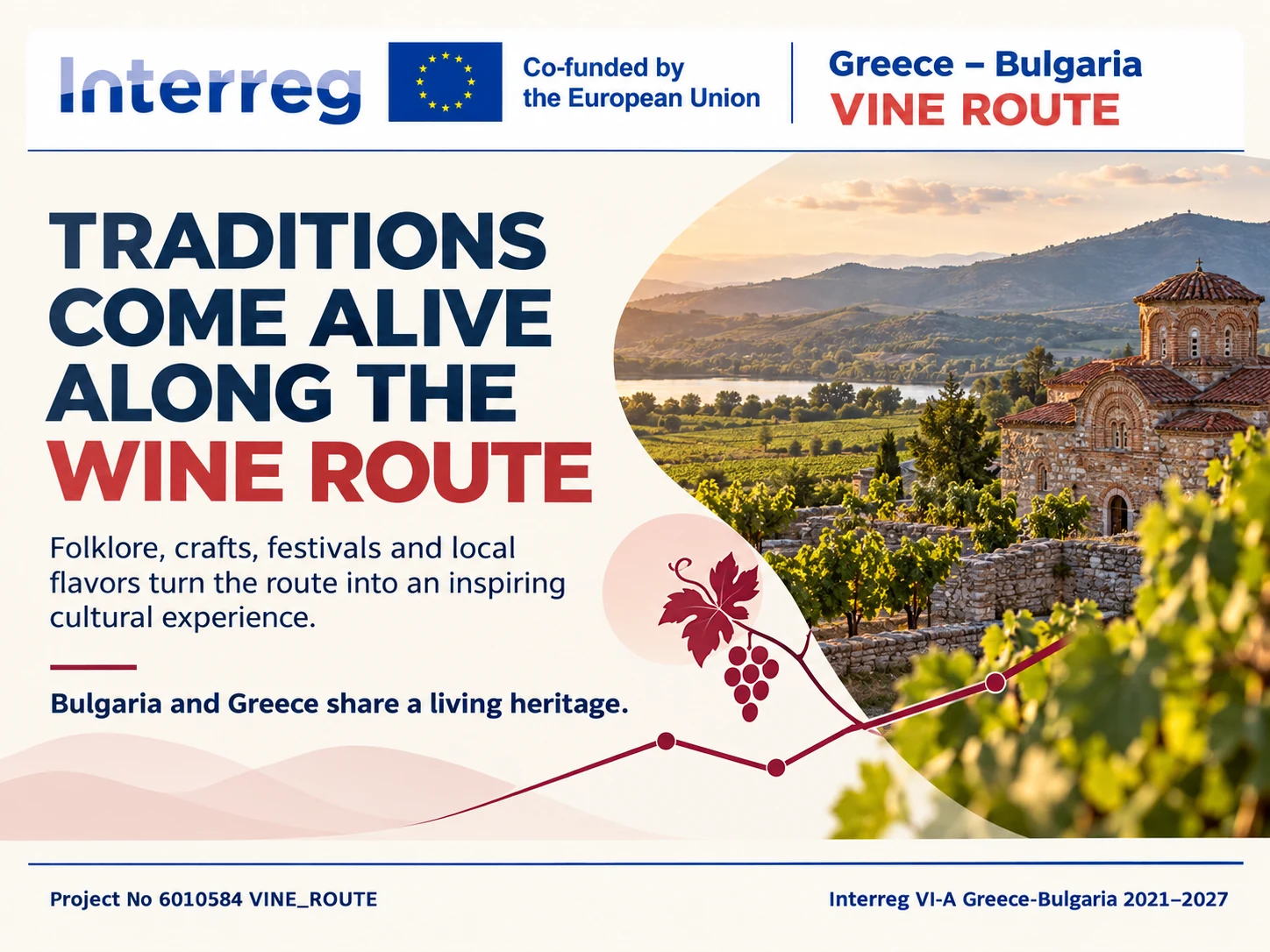
A Tradition Rooted in the Land
In Southern Bulgaria and Northern Greece, the vine forms part of the cultural landscape and of the way communities tell their own stories. Choosing a vineyard site, seasonal care, the grape harvest, wine storage and sharing wine at the table create an annual rhythm. This rhythm brings together natural conditions, practical knowledge and social relationships accumulated and passed down through generations.
Tradition is not the same everywhere. Mountain slopes, river valleys and warmer plains create different conditions for growing grapes. They are associated with local varieties, distinct techniques and family stories. This diversity gives the region its character and allows each place to be presented in its own voice.
The Grape Harvest as a Community Experience
The grape harvest is both work and celebration. It requires organisation and the participation of many people, while also creating an occasion for gathering, music, food and sharing. Family memory often preserves not only the year and quality of a harvest, but also stories about the people, the weather and the events that accompanied it.
Today, some of these practices are changing under the influence of mechanisation and professional production. Nevertheless, grape and wine festivals, demonstrations of traditional activities and meetings with producers continue to turn winegrowing into an experience for residents and visitors. This is an important resource for cultural and wine tourism.
Wine in the Festive Calendar
In Bulgarian tradition, Trifon Zarezan is one of the most recognisable celebrations associated with vineyards and the hope for fertility. Ritual pruning, blessing and the communal meal show how agricultural labour becomes part of festive culture. The custom varies from place to place, while contemporary celebrations often include competitions, music programmes and showcases of local producers.
On the Greek side, wine also features in local celebrations, festivals, religious observances and family occasions. The common element is not that the customs are identical, but that wine represents hospitality, communication and belonging. When presenting these traditions, it is important to seek local specificity: who preserves the custom, how it is practised and what meaning the community gives it today.
Food, Hospitality and Local Flavour
Wine rarely stands apart from food. Local cheeses, meat and vegetable dishes, breads, herbs and seasonal produce shape a complete culture of the table. Combining local wine with regional cuisine allows visitors to discover the area through taste, aroma and conversation with the people who produce the food.
For the tourism route, this means presenting not only wineries but also places where tradition can be experienced responsibly: family farms, farmers’ markets, festivals, restaurants serving regional cuisine, cultural centres, museums and workshops. Each stop adds another layer to the story of wine.
Knowledge and Skills across Generations
Living heritage is preserved through people. Pruning methods, recognising the right moment to harvest, caring for vessels and assessing finished wine are forms of knowledge long acquired through observation and participation. Today, they are complemented by education, laboratory control and new technologies, yet personal experience remains valuable.
Tradition as a Contemporary Resource
Preserving traditions does not mean mechanically reproducing the past. It requires an understanding of which practices matter to the community and how they can be presented without exaggeration or reduction to folkloric decoration. Good interpretation gives local people a voice, uses verified information and shows the relationship between older skills and present-day life.
VINE_ROUTE creates an opportunity to document these stories and connect them within a shared route. Meetings with tourism sites, wineries, cultural institutions and local organisations can gather photographs, information and personal accounts. Once verified, they can be presented in multilingual, cartographic and digital materials reaching a wider audience.
Documenting living heritage should include more than a general description. It should identify the people who hold the knowledge, local words and practices, seasonal activities, recipes, celebrations and the conditions that allow them to continue. People’s consent and proper acknowledgement of the sources of information are essential to responsible presentation. In this way, tourism content does not appropriate tradition but helps it to be recognised and passed on.
Sustainability and Authenticity
Interest in wine tourism brings opportunities as well as responsibilities. Visits must respect the working rhythm of farms and wineries, the capacity of small sites and access rules. Authenticity is not measured by spectacle, but by an honest presentation of the place, its products and its people. A sustainable approach encourages local consumption, longer stays and a wider distribution of benefits.
When traditions are presented in context, visitors understand why vines and wine matter to the region. They see the relationship between nature, labour, celebration and the economy. A journey can thus become a genuine encounter with the living heritage of the cross-border area.
An Invitation to Local Communities
The Cultural Path of Wine will reach its full potential by incorporating different local perspectives. Stories about vineyards, old cellars, celebrations, recipes, crafts and family practices can contribute to a richer picture of the region. Local community participation is therefore not an addition to the route; it is a condition for making the route credible, recognisable and sustainable.
Shared Traditions on Both Sides of the Border
Winegrowing and winemaking traditions do not stop at the border. Similar harvest practices, similar celebrations and a similar attitude to the table are found both in Northern Greece and in Southern Bulgaria – with local differences that make each territory recognisable.
Traditions are therefore documented using a shared methodology by the partners on both sides, so that the materials are comparable and can be presented together. The Bulgarian and Greek sections will be linked into one route, allowing visitors to follow the same tradition in its two local variants within a single journey.
European co-financing
Project No 6010584 VINE_ROUTE – “The Cultural Path of Wine” is implemented under the Interreg VI-A Greece–Bulgaria 2021–2027 Programme. The Archaeological Museum of Thessaloniki is the Lead Beneficiary, and the project partners are Winemakers of North Greece, the Archaeological Museum of Sandanski, and Reconstruction and Development Union – Project Partner 4. The project’s total approved budget is EUR 1,129,676.12.
This publication has been produced with the financial assistance of the European Union. Its contents do not necessarily reflect the views of the European Union, the participating countries or the Managing Authority. The project is co-financed by the European Regional Development Fund and by national funds of the countries participating in the Interreg VI-A Greece–Bulgaria 2021–2027 Cross-Border Cooperation Programme.