
From Site Assessment to Building a Shared Route
A field study was carried out in the four Bulgarian districts covered by VINE_ROUTE to assess the condition and readiness of tourism sites and services. The on-site work had a practical purpose: to verify which wineries, museums, cultural and natural sites actually receive visitors, how they can be reached, what information they provide and what is needed for their inclusion in a functioning tourism route.
The study treats the route as a complete experience rather than merely a list of places. Visitors need a clear sequence of sites, realistic travel times, advance booking options, access to local guides and meaningful links among cultural heritage, wine, food and nature. The teams therefore collected both quantitative data and assessments and proposals from people working in tourism who understand local conditions.
The study is being implemented under Activity 3.4.4 by BIOKONSERV Ltd., commissioned by Reconstruction and Development Union – Project Partner 4. The results will support the development of the Bulgarian sections of the Cultural Path of Wine and their subsequent connection with routes in Northern Greece.
Scope and Methodology
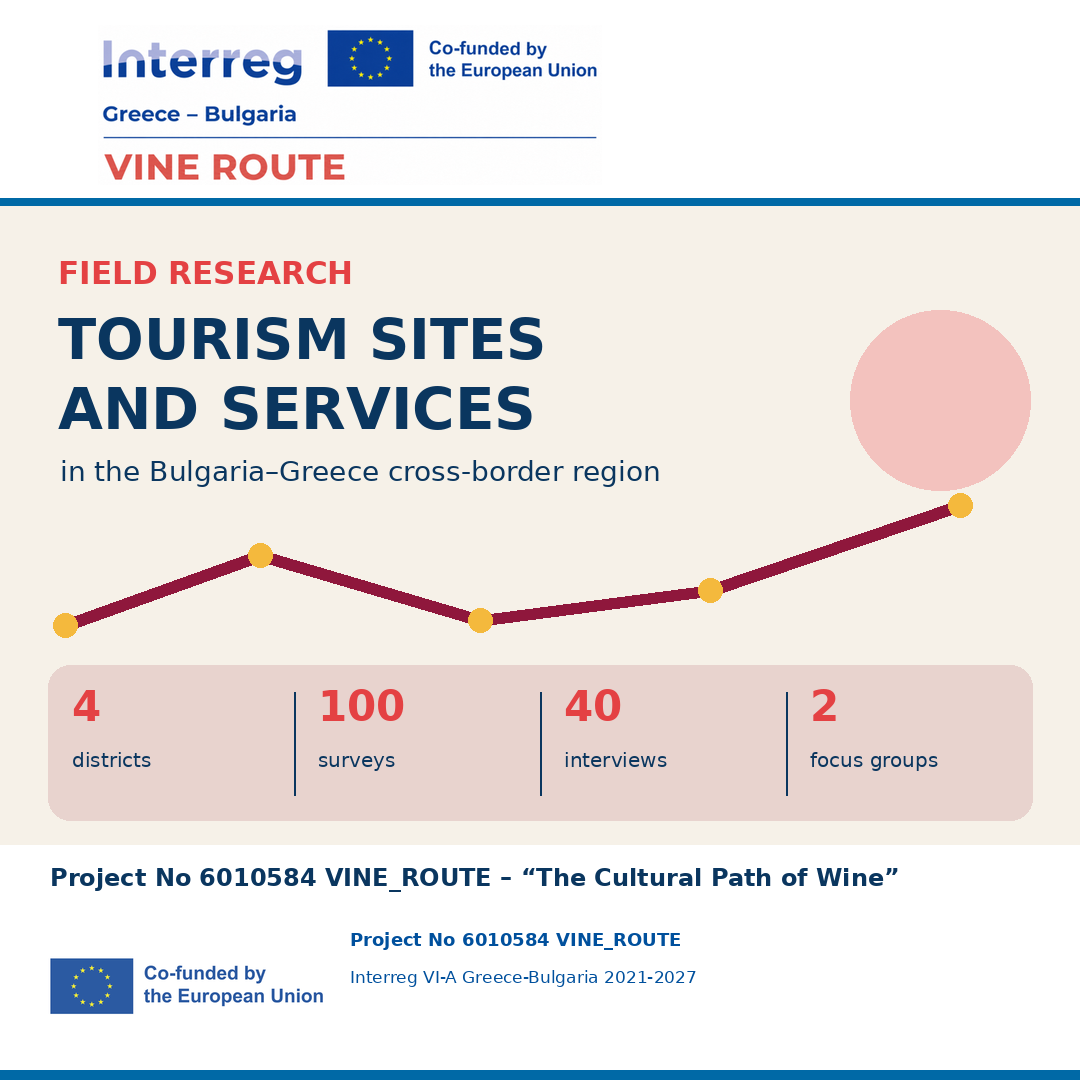
The work combines desk research on documents and tourism information, surveys of visitors and potential visitors, standardised stakeholder interviews and focus groups. Field activities were distributed across the four districts so that the results could be compared.
-
100 questionnaires – 25 in each of the four districts
-
40 standardised interviews – 10 per district with representatives of the tourism sector, wineries, museums, municipalities, information centres, local organisations and experts
-
two focus groups – on 17 September 2026 at the Historical Museum in Svilengrad and on 21 September 2026 in Sandanski
-
photographic recording and documentation of sites, beginning in Haskovo District on 14 September 2026
The interviews were conducted in person, by telephone and online. This made it possible to include participants from smaller settlements and mountain areas, where travel and advance arrangements are more difficult.
Readiness of Sites and Services
During the visits and interviews, attention focused on site access and signage, opening hours, prices and visiting conditions, the availability of information in foreign languages, options for tastings and group visits, service quality and links with other sites in the area. The teams also checked whether online information corresponded to actual conditions on the ground.
This verification matters because a good route depends on every link in the chain. Even an attractive site is difficult to include in an organised trip when it has no current contact details, its opening hours are unclear or access is inadequate. Conversely, a small site can be a valuable stop when it offers a clear story, personal attention and pre-arranged visits.
Different Resources across the Four Districts
Blagoevgrad and Haskovo
Initial observations indicate a strong wine profile. Both districts have operating wineries, vineyards and established experience in organising tastings. This provides a sound basis for routes combining a winery visit with a museum, archaeological or architectural site, local cuisine and an overnight stay. The principal challenge is to arrange the individual offers into realistic programmes and provide reliable booking and transport information.
Kardzhali and Smolyan
Operating wineries are virtually absent in the two Rhodope districts, but their tourism resources are substantial. Thracian sanctuaries and rock complexes, caves, mountain landscapes, crafts and local cuisine provide a different thematic emphasis. These districts can participate fully in the Cultural Path of Wine when historical narratives and local experiences are connected with nearby wine regions and suitable accommodation and dining options.
The differences among the districts do not require a single model for all. Instead, they allow the routes to complement one another: wine centres offer tastings and meetings with producers, while the Rhodopes add cultural heritage, nature, crafts and culinary traditions. The shared product can therefore offer more than one reason to travel and encourage longer stays.
Issues and Proposals Raised by Participants
Several practical difficulties recur in all districts: insufficient directional signage, outdated or fragmented information, the absence of a shared booking system, difficult access and parking at some sites, a shortage of trained guides and limited foreign-language services. The lack of organised transport between destinations is also a serious problem.
For wine visits, transport also has a direct bearing on safety. Participants identified a need for packages combining transfers and accommodation so that visitors do not have to drive after a tasting. Other proposals include seasonal weekend transport links, bilingual signage, a shared digital map with precise coordinates, opening hours and contact details, and the option to request a visit online.
The Role of Local Partnerships
The discussions showed that many necessary improvements depend on coordination among local stakeholders. Municipalities and tourist information centres can maintain current contact details and event calendars, while accommodation providers and restaurants can direct guests to nearby cultural sites and wineries. Local guides and organisations are important for advance arrangements and for presenting the area’s history.
Not every site needs to offer the same services. It is sufficient for each participant to have a clear role and reliable working contacts with the others. Individual offers can then be combined into ready-to-use programmes for tour operators and tourism centres.
The selection process will apply shared practical criteria: a thematic connection to the route, accessibility, safety, current contact details, readiness to receive visitors, advance booking options and links to other services in the area. The collected opinions and data will be processed in aggregated form and used for route planning without revealing the identities of survey and interview participants.
From Individual Sites to a Shared Route
A functioning route must have a clear theme, a logical sequence and a realistic duration. It is necessary to know travel times, site capacities and which visits require advance booking. The connections among the individual participants – wineries, museums, accommodation providers, restaurants, guides, municipalities and tourism organisations – are equally important.
The wine theme should not be applied mechanically across the entire area. In Kardzhali it can be linked to Thracian heritage and local cuisine, while in Smolyan it can connect with mountain routes, crafts and wellness tourism. In Blagoevgrad and Haskovo, vineyards, wineries and meetings with producers can take the leading role. The common thread is the cultural significance of wine and its place in history, livelihoods and contemporary tourism.
Next Steps
The collected information will be processed and presented in an analytical report. It will include a profile of each district, an analysis of strengths and weaknesses, an assessment of the readiness of route hubs and prioritised recommendations. The report will propose thematic routes, measures to improve access and service, and opportunities for combined services linking wine, heritage, cuisine and nature.
The next step is to discuss the proposals with the sites, local coordinators and project partners. The Bulgarian and Greek segments will be compared according to thematic links, geographical proximity and the most suitable border crossing. The aim is for the routes to be viable in practice and to use functioning local services, rather than remain merely a description in a project document.
Benefits for Sites and Visitors
For tourism sites, the shared route can provide greater visibility, coordinated presentation and contacts with other service providers. For visitors, it should offer reliable information, easy planning and the opportunity to combine several different experiences within one journey. The study results will show where minor organisational improvements are needed and where longer-term investment is required.
“We have the sites and we have the story. What is missing is the link between them – the person who will take you there, information about when the site is open, and the package that brings everything together in a single journey.”
Participant in the Svilengrad focus group, 17 September 2026
Contractor for the study under Activity 3.4.4: BIOKONSERV Ltd.
The Cross-Border Dimension of the Survey
The survey presented here covers the Bulgarian part of the project. In parallel, the Greek partners are carrying out their part on the territory of Northern Greece.
Both surveys follow an agreed methodology – with the same readiness indicators for sites, similar instruments and comparable criteria. This allows the results to be merged into one cross-border analysis rather than remaining two separate national reports.
Once the data are merged, the Bulgarian and Greek route sections will be linked through the most suitable border crossings. Before being offered publicly, each direction will be verified by an actual journey – checking the crossing regime, travel time and available service capacity.
European co-financing
Project No 6010584 VINE_ROUTE – “The Cultural Path of Wine” is implemented under the Interreg VI-A Greece–Bulgaria 2021–2027 Programme. The Archaeological Museum of Thessaloniki is the Lead Beneficiary, and the project partners are Winemakers of North Greece, the Archaeological Museum of Sandanski, and Reconstruction and Development Union – Project Partner 4. The project’s total approved budget is EUR 1,129,676.12.
This publication has been produced with the financial assistance of the European Union. Its contents do not necessarily reflect the views of the European Union, the participating countries or the Managing Authority. The project is co-financed by the European Regional Development Fund and by national funds of the countries participating in the Interreg VI-A Greece–Bulgaria 2021–2027 Cross-Border Cooperation Programme.